top of page
Search

Getting started at Site

  • alisonbeach2
  • 3 days ago
  • 2 min read

Michael Williams (MAFS 2026 Student; Student at University of Aberdeen)

 The amazing Lindores Abbey Distillery, found in Newburgh, Fife. Known as the spiritual home of Scoth Whiskey. Claiming the earliest evidence of Scoth whiskey distillation in c. 1494, how’s that!
 The amazing Lindores Abbey Distillery, found in Newburgh, Fife. Known as the spiritual home of Scoth Whiskey. Claiming the earliest evidence of Scoth whiskey distillation in c. 1494, how’s that!
 What an impressive logo on these sliding rail doors. Opposite here is the Abbey founded in 1191 by Tironesian monks. Sadly, during the sixteenth- century Protestant Reformation, the abbey was sacked and burnt, such a terrible waste!
 What an impressive logo on these sliding rail doors. Opposite here is the Abbey founded in 1191 by Tironesian monks. Sadly, during the sixteenth- century Protestant Reformation, the abbey was sacked and burnt, such a terrible waste!


After the site has been set out, and trenches squared up, pegged out and string lines placed, we begin the labour-intensive process of de-sodding, or removing the turf.

With a small trench like this one we do this by hand, using spades, and being very careful not to go to deep! We only need about 30-40 mm taken out.


This is quite hard work depending on how stony the ground is, looking at this corner, someone got lucky!


Now it is all done, time to take a closer look, check for any changes in soil colour which could indicate a context change, also time for levels.


A good start made, with the 1-meter dimensional rod and a north arrow in place, not a real site photo just a casual phone photograph


Oh no, where is the North arrow, dimensional rod and small finds number?


We have a way to go yet, we are looking for possible foundations for walls or even better, evidence of lined drainage systems.


We would also love to find any medieval pottery or kiln related materials.


This is more like how we photograph finds, and not with a phone camera like this one either.


A full set of levels are taken, a context record is completed, and a set of overhead photos are taken with special software on an iPad, then uploaded into the site database called Kiosk.


Ready to be bagged and labelled with its own details, the trench number, a context number and its own special finds number.


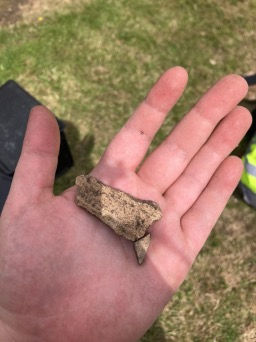
This location has been used from around 1913 to 2017 as a farmer’s yard, so there is a good chance this is a piece of farm equipment or related to farming activity.


Anybody?


Comments


Express interest in our 2027 University of St Andrews courses in Archaeology and Bioarchaeology!
bottom of page