Artifacts, architecture, and archaeology
Zoe Levin (MAFS 2026; Student at St Andrews & The College of William & Mary)
There are as many types of archaeology as there are types of materials in the ground, and one of my favorite parts of this season was learning what each type can tell archaeologists about the past.
I dug in trench 7, a 2x5-meter trench next to the northmost wall of the abbey. Our primary goal was to locate the monastery’s great drain, which we believed we had located by the archway in the exposed portion of the wall.

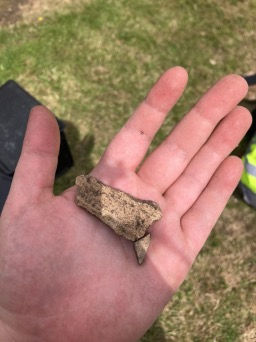
Trench 7 was surprisingly light on artifacts. This was less true at first, when we accumulated half a dozen Victorian small finds in the course of the first week. Nevertheless, we found very few artifacts from earlier periods. I recovered one sherd of medieval French pottery, but the vast majority of our relatively small artifact collection was more modern.

Often, artifacts can show how people lived their day to day lives. Butchered bones can show what people at the site ate, for example, and a collection of toys – which we actually did find – suggests that children might have lived there. Unfortunately, because so few of our artifacts were medieval, our finds taught us very little about how the monks might have lived. Instead, they served to date our contexts; when we found significant quantities of Victorian ceramic or glass in a layer, we knew that it was highly unlikely to be medieval.
The finds that proved the most useful to our research were not actually the artifacts, but the architecture. From the very beginning, the archway in the wall was a guiding point for our excavation We knew that if there was a drain, it likely flowed underneath the arch. Ergo, digging by the arch gave us our best chance of finding the great drain. As the season went on, our architectural features proved to be easily the most fascinating elements of our trench. We uncovered two structures that we believe to be support walls, one on each side of the arch, which supported the existence of the drain in our trench. We were also able to develop theories based on the shapes and materials of stones. In particular, we found what we think could be the base of a gate, based on a dent and a curved scrape in the stone.

It was fascinating to me what we could discover based on what we did – and what we did not – find. Based on typical portrayals of archaeology and my past experience with digging, I assumed artifacts to be the highlight of our work. As a result, it was an amazing learning experience being able to dig a trench with few artifacts but significant architectural finds. They may not always teach us the same lessons, but they are all invaluable clues to the past.
Comments