Connections across the Generations
Yv Scarlett Maciel (MAFS 2026; North Carolina State University alumna)
Before coming to the University of St Andrews, I thought this program would simply teach me how to excavate an archaeological site and better understand medieval monastic life. Instead, it really changed the way I think about history and myself. Looking back, I realize the most valuable things I gained were not just archaeological skills, but a new perspective on humanity and a new confidence I did not know I had.
When I first arrived in Scotland, everything felt unfamiliar. I underestimated the weather
and immediately had to buy a windbreaker. I came from a place where driving everywhere was normal, so walking twenty minutes into town felt impossible. I had never figured out a bus system on my own, and even doing laundry became an adventure after I accidentally paid for the wrong dryer. These moments felt overwhelming, but now they make me laugh because they remind me how quickly I can learn.
The people I met made Scotland feel like home much sooner than I expected. By the end of the program, my dorm room was covered with photo booth pictures, and I had found a community of people.
Excavating at Lindores Abbey completely changed my understanding of archaeology. I
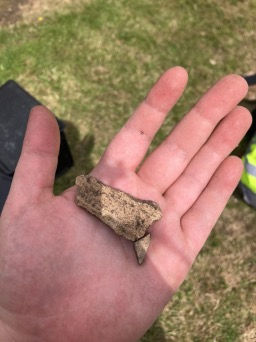
remember the excitement of uncovering my first artifact and realizing I was holding something that had not been touched for generations. One discovery that stayed with me was a pair of Victorian lead children's toys. They became one of my favorite finds because they reminded me that history does not stop when one chapter ends. Reading Roberta Gilchrist's discussion of the "biography of place" helped me understand that Lindores Abbey is not simply the story of monks. It is the story of every person who has left something behind on that landscape. Standing in the trench each day, watching the white horse graze nearby, I often found myself thinking about how many people had stood in that same place before me.
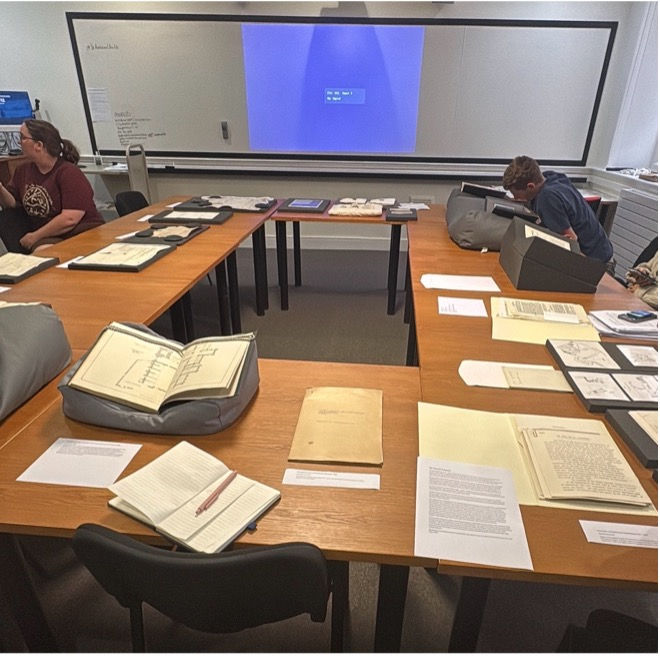
The monastic texts surprised me just as much as the excavation. I found monks struggling with many of the same emotions I experience today. The Letters of Barsanuphius and John reminded me that people have always searched for advice, wrestled with uncertainty, and hoped that changing their surroundings would solve their problems. Bernard of Tiron's reluctance to accept recognition especially resonated with me. Throughout this program, I often wondered whether I truly belonged here since I had never formally studied history. Reading about Bernard made me realize that feelings of self-doubt are not uniquely modern.
Throughout this program, I was constantly reminded that people across centuries are far
more alike than they are different. When I boarded my flight to Scotland, I hoped I would leave with a better understanding of medieval archaeology. I never expected to leave with a greater understanding of myself. This experience gave me confidence to step outside my comfort zone. I know the memories I made at St Andrews and Lindores Abbey will stay with me long after the excavation has ended.
Comments