Looking down...and Looking up
Linday Kalb (MAFS 2026; Student at Brandeis University)
Before this summer, I barely understood archaeology. I had read the program, learned
quick terminology, and prepared to sit through lectures on theory and method. But there is a world of difference between studying archaeology in a classroom and actually doing it.
The MAFS program thrust me into that world, and in the process, it changed not only how i see the past, but how I see myself.
For weeks, our home base was Lindores Abbey, a 12th-century monastic ruin nestled in
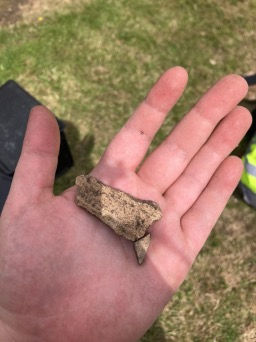
the quiet countryside of Fife. This was where the real work happened. Each day, we would arrive at the site, trowels in hand, ready to carefully peel back the layers of soil that had accumulated over nearly a millennium. We were searching for anything that could illuminate the daily lives of the monks who once called this place home, fragments of pottery, bits of metal, traces of walls and floors. It was slow, meticulous, and often frustrating work. But it was also deeply rewarding. The excavation taught me patience. It taught me to pay attention to the smallest details, because in archaeology, context is everything. A single shard of pottery may be almost meaningless on its own, but placed within its proper layer, alongside other fragments, it can tell a story. I learned to read the soil, to distinguish between natural deposits and human activity, and to appreciate the immense amount of time and care that goes into uncovering even a small piece of the past. The monks of Lindores may be long gone, but their world was slowly coming back into focus, one trowel stroke at a time.
But archaeology isn't just about looking down. It's also about looking around, about
understanding how a site fits into the larger landscape and history.
That lesson came into sharp focus during a class trip to Edinburgh. After weeks of being immersed in the quiet, rural atmosphere of Lindores, the bustling capital felt like another world entirely. We stood at a viewpoint of Edinburgh Castle, the city sprawling beneath us, and I was struck by the contrast. Here was history on a grand, visible scale, monuments built to impress, fortifications designed to protect, a skyline that told the story of a nation.
Standing at that viewpoint, looking out at Edinburgh Castle after weeks of kneeling in the soil at Lindores, I realized that archaeology had given me something far greater than a set of technical skills. It has given me a new way of seeing the world and all its timelines.
I had arrived in Scotland as a student who knew barely anything and doubted my ability to put skills into practice. I leave with dirt under my fingernails, a camera roll full of memories, and a quiet confidence that I can navigate unfamiliar places, connect with people from around the world, and uncover stories that matter. The abbey taught me to look down and pay attention. The castle taught me to look up and see the bigger picture. And in between the two, I found my footing.
This trip has been more than an academic exercise; it has been a transformation. And I cannot wait to see what else I will uncover.
Comments