I wouldn't have had it any other way...
Updated: Jul 12
Lina Rosenblueth (MAFS 2026; Student at the Universidad Iberoamericana de Ciudad de México, México)
Finds or no finds, walls or no walls, cisterns or no cisterns, plastic or no plastic; I wouldn't have had it any other way.
We started our final run with a Bioarchaeology class session, a break I decided to
take in the library sketching away, and a wonderful insight into Archive. I found myself handling the remains and realizing the amount of respect involved in holding someone who once was. It made me want to dive so much further into what skeletal remains can reveal about a past life, and at the same time, it made me question the ethics and history behind our data, wondering where the information for those standard sex and height estimation charts was actually obtained in the first place.
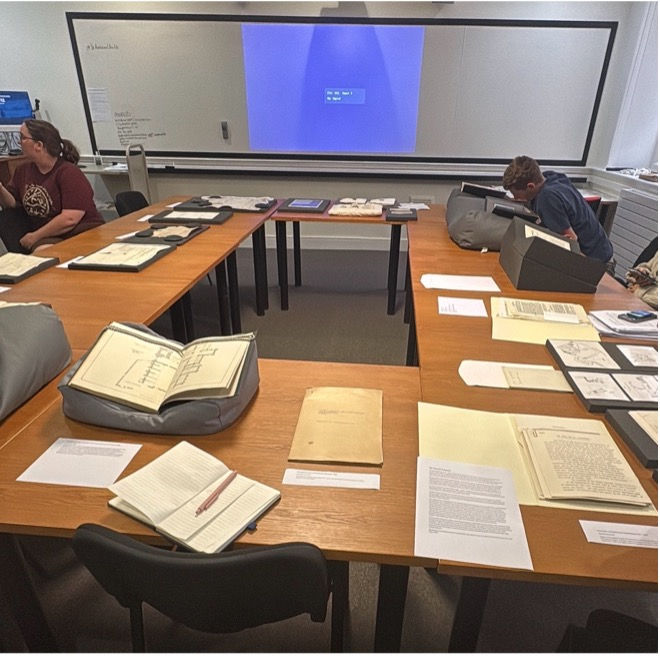
From the lab, we moved into the archives for what turned out to be a hands-on game that had us identifying the fake piece amongst a collection of historical documents and objects. We were all sat around tables, each of us facing a specific piece, scanning it intently for any telltale sign of falsehood, though we had to be incredibly careful, as some of the more fragile documents were strictly off-limits to our hands. Once we all cast our votes, the descriptions were revealed and it turned out the fake was a set of donated "assyrian seals".
The whole exercise got me thinking about the very real threat of forgery and the critical importance of a trained eye, especially for me as an art historian in formation, and down the road, as a potential archaeologist or restorer.
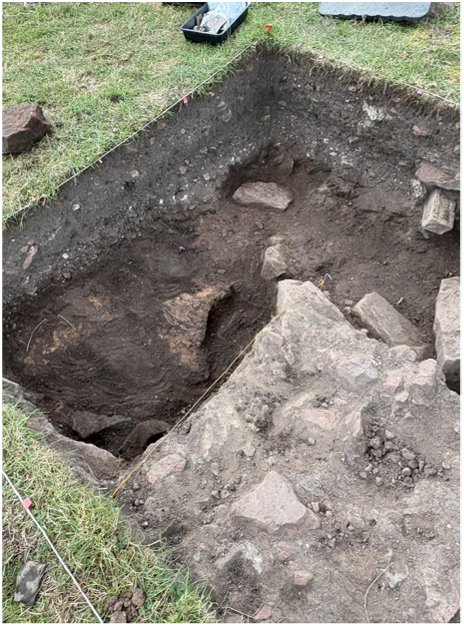
The rest of the day was a complete contrast, I spent hours drawing, focusing on creating a realistic visual representation of our exhibit proposal so that everything we had envisioned actually came to life on the screen. The following day we took examinations and cleaned our trench, exploring the layer we were closest to and trying to see what could be waiting below it. Digging under our clumps of clay, we found a hole, but rather than clarifying our trench supervisor’s hypothesis, it only brought up a flood of new questions.
With the trench keeping us guessing, I spent the rest of the day retrieving information and taking photographs of how certain spots of the abbey look now compared to how they did in the 19th century; our presentation revolved around the past, present, and future, so these visual parallels were crucial. I also visited the distillery to photograph and analyze the historical elements they already have on display, since I wanted to take their preexisting space and aesthetic into consideration when creating my own design. With only our final presentation left to go, I was determined to bring my vision to life and unite history, whisky, and archaeology into one exhibit.


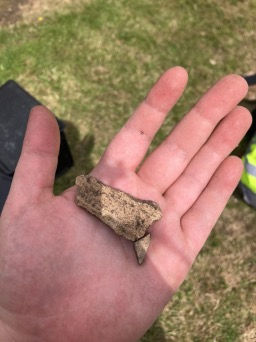
Thursday, June 2, was Open Day. I was called in to help at Trench 7, the drainage trench, since my own trench was finishing up section drawing and it really wasn't a four-person job. The experience of being in a completely different trench for a day was incredible. Within the first few minutes of my transfer, one of my temporary trench mates found a large, possibly 18th-century key!

The week ended with a very impactful, bittersweet backfill. We had to fill every single excavation back up. All the soil we had meticulously bucketed out over the weeks had to go right back in. In a few months' time, only we will know what lies under those patches of grass. For a month, we were archaeologists and no matter how unlucky in terms of finds we might have been, we were easily the luckiest when it came to our trench mates, trench supervisor, and how kind Trench 19 was to us when it came to learning archaeology. I wouldn't have had it any other way. And with that, we gave a final, fond farewell to our dear square.

Comments