The Excitement of excavation
Ava Anthony (MAFS 2026; Student at Franklin and Marshall College)
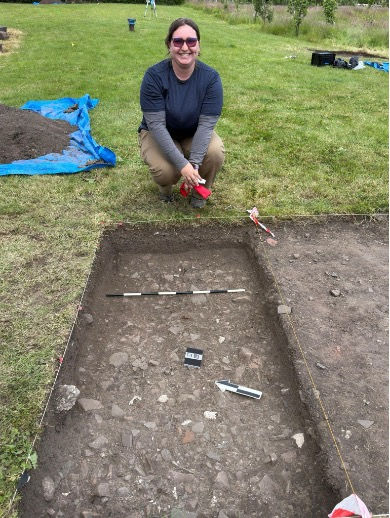
The most exciting aspect of field school, to me, is actually being in the field. While I enjoy lectures and field trips, these cannot compare to the experience of opening up your trench. At the end of week 3, my trench, Trench 18, opened up a new section on the western side. It brought me back to my first day on site, when we removed the sod and carefully started excavating Context 002. Every stone was exciting, and I gleefully counted the poor worms that were disturbed along the way.
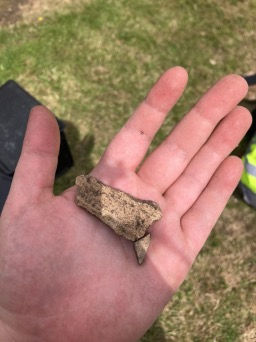
My delight at worms and rocks has not completely waned, but has tempered down a healthy amount. Worms are still counted but hurriedly thrown into the grass. Rocks are looked at with a more careful eye, an eye that now knows to look for nail holes in slate and worked edges in red sandstone. Opening up a new section of the trench made me realize just how much I had learned in the past few weeks.
In particular, Trench 18 has helped me realize what an impact the actions of the Victorians had at the site. In archaeology, you call layers of material contexts, with the sod being the first context. Our second context was a layer of dirt, with mostly rocks with some animal bones and pottery interspersed. The third was a thick layer of rubble. Mostly rock, but with a lot of oyster shells and animal bones. It also had pottery, medieval, victorian, and modern. Then, a layer of clay, and finally, our lowest layer, another layer of rubble. We hoped, with this being the lowest, and therefore oldest, layer, that it would be only medieval. Unfortunately, our trench supervisor, Professor BH, found a shard of victorian transferware in the context.
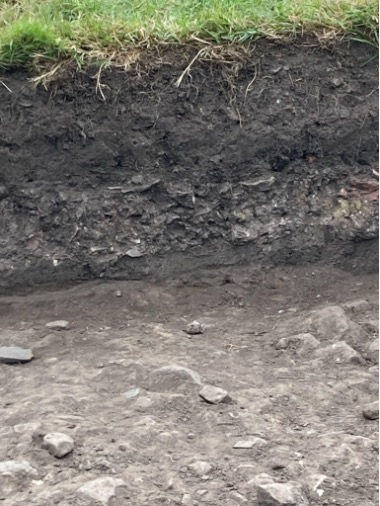
The reason why we don’t want to see anything Victorian is because we want to excavate in undisturbed layers. The deposit of rubble that the victorian shard was in means that the last people to see that layer were the Victorians, and while the Victorian era is interesting in its own right, we are interested in the medieval monastic history of the site. Anything medieval in that layer was messed with by the Victorians, which makes it less compelling than something that is untouched. Although this is disappointing, it means we can get through context 5 and into the next layer, which I hope will be medieval. Our new section will also have to be brought down as well, which we hope will reveal a medieval wall.
Comments