Jr Archaeologist Day on Site
Cay Olsen (MAFS 2026; Student at Haverford College)
This past week was eventful at Lindores Abbey. On Wednesday, we welcomed 2 groups of elementary school students who were learning about the dinosaurs. Unfortunately for them, there are no known dinosaurs at Lindores Abbey, but we still did our best to teach them all about the abbey and archaeology as a subject.

After bringing the children into the cloister and explaining what monks did in their everyday life, Dylan and I showed them around trench 7. It was there where we explained to them how we thought the river Tay was several meters higher, back when the abbey was formed in 1191, than it is today. We told them that by using those higher water levels, the monks who occupied Lindores Abbey were able to take advantage of the high tide and flush away all of their sewage and waste.
On our way towards the two piscinas, one child asked Dylan and me what the monks looked like, and they were all rather surprised when I told them that they looked like all of us standing on the northern side of the abbey. They were even more surprised when we showed them the two piscinas and they noticed that neither one had faucets, and that the monks had to manually bring the water up to the sinks in order to wash whatever needed to be washed.
My favorite part about taking both groups of school children on a tour around the site was their questions. They were full of such curiosity and many of them made us laugh. My personal favorite was whether the monks had a television. But there were also a lot of very engaging conversations that were spurred on by questions. The one that comes to mind was when one of the school children asked why I didn’t get to keep any of the things that we found in the ground, and it was a wonderful opportunity to explain my own, and many other archaeologists’ motivation for wanting to conduct field surveys and excavations as well as research unknown parts of history. Many of us do it because we are genuinely interested in the history of a region and what happened during a specific time period, and not in the monetary value we could potentially get from selling an artefact we found.
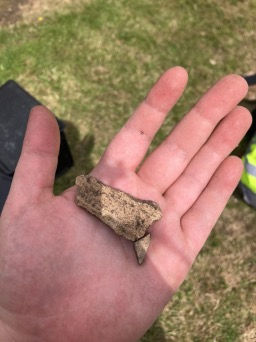
I finished off their tour after a half hour mock dig activity by taking them trench 19 across the street and gave them a chance to hold different types of pottery and bones we had found throughout the past two and half weeks. Overall, both the archaeologists excavating and the students visiting the site had a blast that day.
Comments